
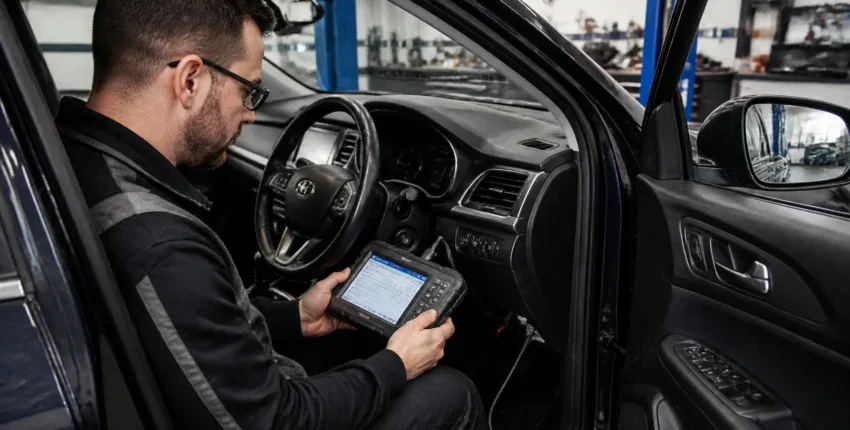
It happens when you least expect it. You’re driving down Bayfield Street or heading out for a weekend at the cottage when that little amber glow appears on your dashboard. The check engine light: formally known as the Malfunction Indicator Lamp (MIL): is perhaps the most misunderstood notification in your vehicle. For some, it’s a source of immediate anxiety; for others, it’s a nagging nuisance they hope will just go away on its own.
At Auto Tech Solutions Inc., we see dozens of vehicles every week for check engine light diagnosis in Barrie. While many drivers assume the light means a mechanical part has physically snapped or failed, the reality of modern vehicle ownership is much more complex. Your car is essentially a high-powered computer on wheels, and sometimes, that light isn’t telling you to buy a new part: it’s telling you that your car’s “brain” needs a software patch.
Here are the ten most common reasons your check engine light is on, ranging from the simple $20 fix to the advanced programming updates that only a specialized shop can handle.
1. A Loose, Damaged, or Missing Gas Cap
It sounds almost too simple to be true, but the gas cap is a critical part of your car’s evaporative emissions (EVAP) system. This system prevents gasoline vapors from escaping into the atmosphere. If the cap isn’t tightened properly or if the seal is cracked, the system detects a leak and triggers the light.
If your light comes on right after a trip to the gas station, pull over and check the cap. If it’s loose, tighten it until it clicks. It may take a few drive cycles for the light to turn itself off once the pressure is restored.
2. Failing Oxygen (O2) Sensors
Your oxygen sensors monitor how much unburned oxygen is in the exhaust as it leaves the engine. This data helps your vehicle’s computer adjust the air-fuel mixture for optimal performance and fuel economy. Over time, these sensors can become coated in oil ash or carbon buildup, causing them to send incorrect data.
Ignoring a bad O2 sensor won’t just keep the light on; it can decrease your fuel economy by up to 40%. Given current gas prices, getting a diagnostics and programming check is much cheaper than overpaying at the pump every week.
3. The Catalytic Converter
The catalytic converter is responsible for turning harmful carbon monoxide into less harmful emissions. Usually, a catalytic converter doesn’t fail on its own: it’s often “killed” by another issue, like neglected spark plugs or a faulty O2 sensor that allowed the engine to run too “rich” for too long.
In Barrie, we often see converter issues exacerbated by short winter trips where the engine never quite reaches full operating temperature. While this is one of the more expensive repairs, catching the root cause early can save you from a repeat failure.
4. Mass Airflow (MAF) Sensor Issues
The MAF sensor measures the amount of air entering the engine to determine how much fuel is needed to run efficiently. If this sensor is dirty or failing, you’ll notice your car hesitating under acceleration, stalling, or idling roughly. Often, the sensor can be cleaned rather than replaced, but it requires a delicate touch and the right chemical cleaners.
5. Worn Spark Plugs and Ignition Coils
Think of your spark plugs as the “heartbeat” of your engine. They provide the spark that ignites the fuel-air mixture. In our cold Ontario winters, your ignition system has to work significantly harder to start the car. If your plugs are worn or your ignition coils are failing, you’ll experience “misfires.”
A misfiring engine is a serious problem because unburned fuel can dump into the exhaust, quickly destroying your expensive catalytic converter. If your check engine light is flashing, this usually indicates an active misfire, and you should pull over and call for a tow service immediately to avoid catastrophic damage.

6. Vacuum Leaks
Every engine has a vacuum system that helps with everything from brake boosting to emissions control. Over time, the rubber hoses can dry out and crack, especially with the extreme temperature swings we experience here in Simcoe County. A small vacuum leak can cause the engine to run “lean,” triggering a check engine light and causing a high or surging idle.
7. Exhaust Gas Recirculation (EGR) Valve
The EGR valve helps lower the amount of nitrogen oxide that comes out of your car’s engine by recirculating a portion of the exhaust gas back into the engine cylinders. Over time, the valve can get stuck or clogged with carbon buildup. This is particularly common in high-mileage vehicles or those used for heavy fleet maintenance services.
8. Battery and Charging System Issues
While most cars have a separate battery light, a failing battery or an alternator that is overcharging/undercharging can create “ghost” codes in the system. Modern cars require a very stable voltage to keep their various modules happy. If the voltage drops too low during startup, the computer might get confused and throw a code for a sensor that is actually working perfectly fine.
9. Thermostat Failure
Your car’s thermostat regulates the flow of coolant to keep the engine at a steady temperature. If the thermostat gets stuck open, the engine will take too long to warm up. The computer monitors this “warm-up time,” and if it doesn’t reach the target temperature within a specific window, it will trigger the check engine light. This is a common issue we see during the first few weeks of a Barrie winter.
10. The Surprise Entry: Outdated Software (ECM/PCM Reprogramming)
This is the reason that catches many drivers: and even some general repair shops: off guard. Sometimes, there is absolutely nothing mechanically wrong with your car.
Manufacturers like Ford, GM, Toyota, and Honda frequently release software updates for your vehicle’s Engine Control Module (ECM) or Powertrain Control Module (PCM). These updates are designed to:
- Fix “nuisance” codes where a sensor is being too sensitive.
- Improve transmission shifting patterns.
- Adjust fuel mapping for better cold-weather starts.
- Correct bugs in the emissions monitoring logic.
At Auto Tech Solutions Inc., our team includes certified Class “A” 310S Red Seal technicians who specialize in advanced diagnostics and programming. We have the same factory-level equipment as the dealerships, allowing us to “reflash” or update your car’s software. If a shop tells you to “replace the computer,” come to us first. Often, the computer just needs a software update to clear that stubborn light for good.
Why a “Code Reader” Isn’t a Diagnosis
You might be tempted to go to a local parts store and have them read your code for free. While this gives you a starting point (like “P0420 – Catalyst System Efficiency Below Threshold”), it doesn’t tell you why the code is there.
Is the catalytic converter bad? Or is there a software bug? Is there an exhaust leak? Or is the rear O2 sensor lying?
A code is just a symptom, not a diagnosis. Real vehicle diagnostics involves testing the circuits, checking for software updates, and performing physical inspections to find the root cause. This “test, don’t guess” approach saves you money in the long run by ensuring you aren’t paying for parts you don’t actually need.
Keeping Your Car Healthy in Barrie
Whether you’re driving a brand-new hybrid or trying to keep your trusty truck on the road past 300,000km, the check engine light is your vehicle’s way of asking for help. Ignoring it usually leads to more expensive repairs down the road.
If that amber light is staring you down, don’t let it ruin your day. Our team at Auto Tech Solutions Inc. provides transparent pricing, flexible financing options, and the technical expertise to handle everything from a simple gas cap replacement to complex ECM reprogramming.
Ready to get that light turned off correctly the first time? Book your appointment online or stop by our shop in Barrie to see what precision automotive care really looks like.