
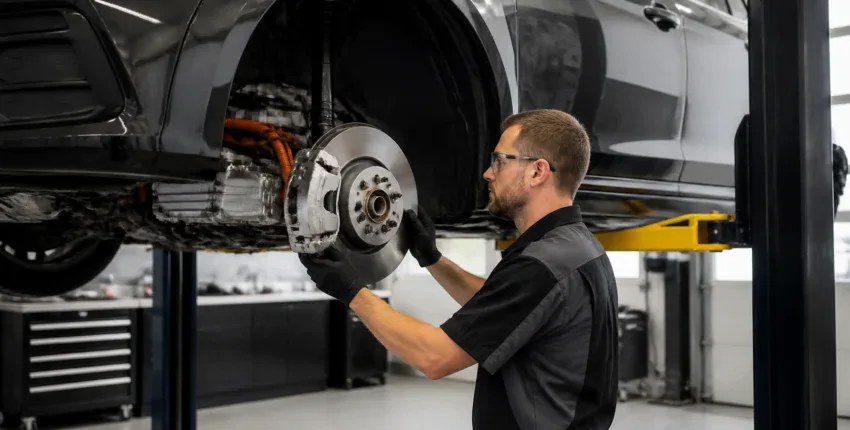
If you’ve made the switch to a hybrid vehicle, you probably did it for the fuel savings and the quieter ride. You’ve likely heard that one of the biggest “perks” of owning a hybrid is that you rarely have to change your brakes. While it’s true that hybrid brake pads can last twice as long: or even three times as long: as those on a traditional gas car, there is a catch. In a climate like ours in Barrie, Ontario, “less wear” doesn’t actually mean “less maintenance.”
In fact, the way hybrid brakes work creates a unique set of challenges that can lead to unexpected failures if they aren’t handled by someone who understands the tech. If you’ve been wondering whether you really need specialized hybrid brake service in Barrie, or if any old shop can handle it, the answer lies in the science of how your car stops.
Understanding the “Invisible” Brake System
To understand why hybrid maintenance is different, we have to look at what’s happening when you press the pedal. In a normal car, pressing the brake squeezes pads against a metal disc (the rotor). This creates friction, which turns motion into heat and stops the car.
In a hybrid, you have two systems working together. The first is regenerative braking. When you lift your foot off the gas or lightly press the brake, your electric motor actually reverses its role. It becomes a generator, creating resistance that slows the car down while sending electricity back into your battery.
Think of it like a parachute. It’s a very effective way to slow down without actually touching your physical brakes. Because the parachute (regen) does about 70% of the work in city driving, your physical brake pads stay cool and tucked away. This is great for your wallet at the pump, but it’s the root cause of why hybrids need specialized care in the “Salt Belt” of Ontario.
The Problem with “Tucked Away” Brakes
Because your friction brakes aren’t being used as often, they don’t get hot. On a traditional car, that heat helps burn off moisture and the friction of the pads helps “scrub” rust off the rotors. On a hybrid, the rotors can sit there, cold and damp, for miles.
For drivers in Barrie, this is a recipe for disaster. Between the humidity from Lake Simcoe and the heavy road salt used on the 400 and local roads, those unused metal parts begin to corrode much faster than they would on a gas-powered vehicle.
The Barrie Factor: Why Our Winters Are Tougher on Hybrids
Living in Ontario means our vehicles deal with some of the harshest conditions in North America. When we talk about maintaining your hybrid for longevity in Ontario’s climate, the brakes are often the most overlooked component.
The salt used on our roads is incredibly corrosive. In a gas car, the frequent use of the brakes keeps the caliper slide pins moving and the rotor surfaces clean. In a hybrid, the lack of movement allows that salt and grit to settle into the moving parts.
Over time, the “ears” of the brake pads can seize into the brackets, or the caliper pins can get stuck. You might have 80% of your brake pad material left, but if the pads are seized and can’t move to squeeze the rotor, your stopping distance increases significantly. This is why a simple “visual inspection” through the spokes of your rims isn’t enough for a hybrid.

Why “Specialized” Service Matters
You might wonder, “Can’t I just take it to any shop?” While many mechanics are great at what they do, hybrid systems require a specific set of tools and knowledge. At Auto Tech Solutions, our Red Seal Endorsed technicians are specifically trained to handle the complexities of these high-voltage systems.
1. The Computer Control Factor
In a hybrid, your brake pedal isn’t always directly connected to the hydraulics in the way you might think. It’s “brake-by-wire.” The car’s computer decides how much regenerative braking to use versus friction braking. If you try to perform a standard brake fluid flush without the right scan tools to “talk” to the car’s computer, you can actually trap air in the system or even trigger a total system shutdown.
2. High-Voltage Safety
Hybrids use bright orange cables that carry enough voltage to be lethal if mishandled. A certified hybrid/EV technician in Barrie knows exactly where these components are and how to safely disable the system before performing work near the electric drive units that control the regenerative braking.
3. The Fluid Problem
Brake fluid is “hygroscopic,” which is a fancy way of saying it absorbs moisture from the air. In a gas car, the heat from the brakes helps keep the fluid stable. In a hybrid, the fluid stays cooler, which can lead to moisture buildup over time. This moisture can cause internal corrosion in the expensive ABS and regenerative braking actuators. Replacing those components can cost thousands, whereas a specialized fluid flush is a fraction of that cost.
Signs Your Hybrid Brakes Need Attention
Because regenerative braking masks so many issues, you might not feel a problem until you have to make an emergency stop. However, there are a few “tells” that Barrie drivers should watch for:
- A “Crunchy” Sound: If you hear a grinding or scraping sound when you first start driving in the morning, that’s often rust on the rotors. If it doesn’t go away after a few stops, your pads might be seized.
- The “Hand-Off” Feel: If you feel a slight surge or a “bump” in the pedal as you come to a complete stop (usually around 10-15 km/h), your car is struggling to transition from electric braking to physical braking.
- Pulling to One Side: This is a classic sign of a seized caliper. One side is working harder than the other because the other side is stuck.
- Warning Lights: Any yellow or red brake icons on your dash are an immediate signal to get a professional diagnosis. Unlike a gas car, these lights often indicate a software or sensor issue rather than just worn pads.
Avoiding common brake mistakes starts with realizing that your hybrid isn’t just a “car with a big battery”: it’s a sophisticated computer on wheels that requires a different maintenance philosophy.
The Hybrid Maintenance “Sweet Spot”
For drivers in the Barrie and Simcoe County area, we recommend a “Clean and Lube” service at least once a year, ideally when you are swapping your winter tires. During this service, we don’t just look at the pads; we take them out, clean the corrosion off the brackets, and apply specialized high-temperature lubricant to the slide pins.
This proactive approach ensures that when you do need to slam on the brakes to avoid a deer on a dark backroad or a sudden stop on the 400, your friction brakes are ready to perform at 100%.
Conclusion
So, do you really need specialized hybrid brake service? The truth is, your hybrid is built to last, but it isn’t built to ignore. The very technology that saves you money at the gas station can actually lead to the premature failure of your braking system if it isn’t maintained with the right expertise.
Don’t wait for a “spongy” pedal or a scary moment in traffic to find out if your brakes are working correctly. At Auto Tech Solutions Inc., we combine the latest diagnostic technology with the hands-on experience of Red Seal technicians to keep your hybrid running safely and efficiently.
Is your hybrid due for a check-up? Give us a call or stop by our shop in Barrie today. We’ll perform a comprehensive digital inspection to show you exactly how your braking system is holding up against the Ontario elements.